




- Digital Savings AccountDigital Savings Account
 Savings AccountSavings AccountCurrent AccountCurrent Account
 - Life Phases
Discover meaningful conversations with industry experts
Perspectives that inform and inspire
Visit Open DialoguePlan Life GoalsDiscover meaningful conversations with industry experts
Perspectives that inform and inspire
Visit Open DialogueLearn Financial ConceptsDiscover meaningful conversations with industry experts
Perspectives that inform and inspire
Visit Open DialogueFinancial FirstsDiscover meaningful conversations with industry experts
Perspectives that inform and inspire
Visit Open DialogueBlogsDiscover meaningful conversations with industry experts
Perspectives that inform and inspire
Visit Open DialoguePlan-o-meterDiscover meaningful conversations with industry experts
Perspectives that inform and inspire
Visit Open DialogueOpen Dialogue PodcastDiscover meaningful conversations with industry experts
Perspectives that inform and inspire
Visit Open Dialogue












Taxation
What’s in a name? A lot, if they are ITR forms
12 min read
Dec 22, 2020
647 Views
This year, the due date of filing returns (for the Assessment Year 2020-21) by individual assessees has been extended up to December 31, 2020, from the general due date of July 31, 2020. While you get your tax certificate and other documents ready, you must also figure out which Income Tax Return (ITR) Form is meant for you. It can be confusing since the tax department notifies ITR forms for different categories of taxpayers every year and the names of these forms don’t reveal much about them.
For the Assessment Year (AY) 2020-21, the forms that have been notified are ITR-1, ITR-2, ITR-3, ITR-4, ITR-5, ITR-6, and ITR-7. Which ITR form to use will depend on whether you are an individual taxpayer, part of a Hindu Undivided Family, an Association of Persons, A Body of Individuals, and so on. It will also depend on the source of income – salary income or profits from business, etc, and the total amount of income earned. For instance, the ITR forms for individuals earning under the same bracket of income will be different if the income is only from salary, or only from profession or from salary and business, and so on. [Also Read: Tax Saving Tips & Schemes]
[Also Read: Tax Saving Tips & Schemes]
Here is a snapshot of the various ITR forms that are normally applicable to individual assesses:
| ITR | Total annual Income | Sources of Income | Type of resident | Does not apply if: |
|---|---|---|---|---|
| ITR-1 or Sahaj | Up to Rs 50 lakh | Salary income, Income from other sources, Agricultural income up to Rs 5000 | Individual resident assesses (other than not ordinarily resident) | You are director in a company Have invested in unlisted equity shares Earn capital gains, have income from business and profession, from house property and wish to carry forward losses Earn income from horse races, lottery, legal gambling, etc. Own assets abroad [including financial interest on any entity] Are assessable in respect of income of another person in respect of which tax is deducted in the hands of the other person |
| ITR-2 | Salary/Pension Income from house Property where the loss is brought forward/carried forward Capital Gain -Short Term and Long Term Other Sources including betting on horse races, lottery, other legal gambling, etc Agriculture - more than Rs 5,000 Foreign assets and foreign income If you are Director in a company Investment in unlisted equity shares Income of spouse, child, etc. is clubbed with yours | Individual resident Individual not ordinarily resident Individual non-resident (even if total income is less than Rs 50 lakh in all three cases) HUFs (not having income from profits and gains of business or profession) | You are an individual or HUF having profit or gains from business or profession You are eligible to file ITR-1 or Sahaj | |
| ITR-3 | Profits and gains of proprietary business or profession Director in a company, Partner of a company Investment in unlisted equity shares Salary, house property, capital gains, other income including horse races, lotteries, etc | Individual Resident Individual not ordinarily Resident Individual Non-resident HUFs having income from profits or gains from business or profession | ||
| ITR-4 or Sugam | Presumptive income from business and profession under Section 44AD, 44ADA, 44AE | Up to Rs 50 lakh | Resident individuals HUFs Firms (other than LLPs) | Income is above Rs 50 lakh Turnover of business/profession is more than Rs 2 crore You are Company director You have invested in unlisted equity shares Are signing authority in any account outside India Have brought forward a loss to be carried forward under any income head You are “Resident but not ordinarily resident’ or “Non-resident” You are assessable in respect of income of another person |
Keep in mind e-filing income-tax return is made mandatory almost for all ITR Forms and assessees.
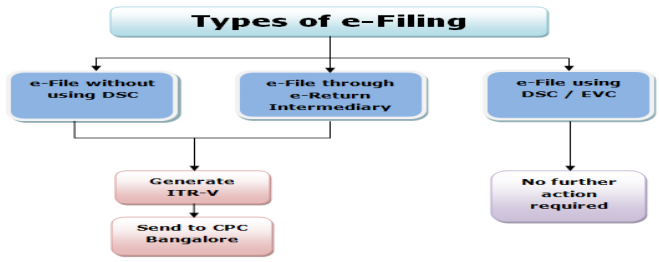
The ways to e-file the ITR:
(Source: https://www.incometaxindiaefiling.gov.in/)
Once the return is uploaded and filed correctly, an acknowledgement of filing the return of income is issued in Form ITR-V. One copy of ITR-V, duly signed by the taxpayer, is to be sent (within the period specified in this regard, i.e., 120 days) by ordinary post or speed post to “Income-tax Department – CPC, Post Bag No. 1, Electronic City Post Office, Bangalore–560100 (Karnataka) if the return is filed without a digital signature.
What happens if you use the wrong ITR?
Filing ITR is not just a constitutional duty but even a moral one by reporting all the income. Failing to do so may attract notices and penalties from the income tax department. If you use the wrong ITR form, the application will not go through. Since all financial transactions are linked to your PAN, there is a record of all your income and investment details. Hence, it is essential to use the right ITR-form that is relevant to you. If you are not sure how to file the returns or are confused about which is the right ITR form for you, do consult an expert or a professional for the same.
Read on for details on the various ITR forms and for ways to file the ITR:
Form ITR-1 – Popularly known as Sahaj, this form is for individual resident assessees (other than not ordinarily resident) having total income up to Rs 50 lakh. The sources of income allowed for Sahaj includes:
✓ Income from Salary
✓ Income from House Property [including where the property is owned in joint name but excludes cases where the loss is brought forward/carried forward from the previous years]
✓ Income from Other Sources
✓ Agriculture income up to Rs 5,000
Sahaj is not applicable if you are:
• An individual who is a Director in a company
• Have invested in unlisted equity shares during the financial year
• Earned capital gain tax
• Earning income from business and profession
• Earning income from more than one house property [and who wish to avail the benefit of carrying forward and set of loss]
• Earned income from horse races, lottery, legal gambling, etc.
• Owning assets abroad [including financial interest on any entity]
• Assessable in respect of income of another person in respect of which tax is deducted in the hands of the other person
Form ITR-2 – This form is for individual [resident not ordinarily resident and non-resident] (even in case of total income below Rs 50 lakh) and HUFs not having Income from profits and gains of business or profession. So, effectively it applies to income from the following sources:
✓ Income from Salary/Pension
✓ Income from House Property [when there is income from more than one property and includes cases where the loss is brought forward/carried forward from the previous years]
✓ Income from Capital Gain [Short Term and Long Term]
✓ Income from Other Sources [includes betting on horse races, lottery, other legal gambling, etc.]
✓ Income from agriculture is more than Rs 5,000
✓ Owning foreign assets and earning foreign income
✓ If you, the individual are a Director in a company
✓ If you have invested in unlisted equity shares at any time during the financial year
✓ If the income of another person such as your spouse, child, etc. is clubbed in your, the assessee’s total income vide the clubbing provisions of the Income-tax Act, 1961.
Form ITR-2 cannot be filed by…
• Individuals who are eligible to file ITR-1 or Sahaj
• Individuals and HUFs having Income from Business and Profession
Form ITR-3 – This form is for individual [resident not ordinarily resident and non-resident] and HUFs having income from profits and gains of business or profession [both tax audit and non-audit cases]. It is applicable in case of proprietary business or profession.
It can also be filed in the following cases:
✓ If you are a Director in a company
✓ Have earned income as a partner of a company
✓ Have invested in unlisted equity shares during the financial year
✓ And may have earned Income under the head: Salary, House Property, Capital Gains, and Income from Other Source [including betting on horse races, lotteries, legal gambling, etc.]
Form ITR-4 – This form, popularly known as Sugam, is for resident Individuals, HUFs and Firms (other than LLPs) with a total income of up to Rs 50 lakh and having presumptive income from business and profession computed under section 44AD, section 44ADA, or section 44AE of the Income Tax Act.
This Form cannot be filed if…
• The total income earned in the financial year is over Rs 50 lakh
• The turnover of the business/profession exceeds Rs 2 crore
• You are the Director of a company
• You have or had invested unlisted equity shares during the financial year
• You have income from more than one house property
• You have brought forward a loss or losses to be carried forward under any head of income
• You have signing authority in any account located outside India
• You own foreign assets or have foreign income
• You are ‘resident but not ordinarily resident’ and ‘non-resident’
• You are assessable in respect of income of another person in respect of which tax is deducted in the hands of the other person
Forms ITR-5, ITR-6 and Form ITR-7 apply to groups of individuals or persons, firms, registered trusts, companies, etc, and not to individual taxpayers. Form ITR-7 may apply to a person who is required to furnish returns under certain sections, namely, 139(4A) or 139(4B) or 139(4C) or 139(4D) only.
Please note – The ITR forms notified for AY 2020-21 consist of “schedule DI” to claim deductions for investments during the extended period from 1 April 2020 until 31 July 2020.
Disclaimer: This article has been authored by Personal FN, a Mumbai based Financial Planning and Mutual Fund research firm. Axis Bank doesn't influence any views of the author in any way. Axis Bank & Personal FN shall not be responsible for any direct / indirect loss or liability incurred by the reader for taking any financial decisions based on the contents and information. Please consult your financial advisor before making any financial decision and before filing the return.
Table of Contents
Related Services
Learning Hub
Planning your next money move? Spend a minute here


Copyright@ 2026 Axis Bank