













Bootstrapping: Building with your own resources
Bootstrapping means starting your business using personal savings, early revenues, or support from friends and family, without external funding.

Discover meaningful conversations with industry experts
Perspectives that inform and inspire
Visit Open Dialogue
Discover meaningful conversations with industry experts
Perspectives that inform and inspire
Visit Open DialogueDiscover meaningful conversations with industry experts
Perspectives that inform and inspire
Visit Open DialogueDiscover meaningful conversations with industry experts
Perspectives that inform and inspire
Visit Open DialogueDiscover meaningful conversations with industry experts
Perspectives that inform and inspire
Visit Open DialogueDiscover meaningful conversations with industry experts
Perspectives that inform and inspire
Visit Open DialogueDiscover meaningful conversations with industry experts
Perspectives that inform and inspire
Visit Open Dialogue
You have the idea. Maybe even early customers. Then comes the real question.
Do you grow slowly with your own money, borrow and repay steadily, or bring in investors and scale fast?
Let’s break the three main funding paths clearly.
Bootstrapping means starting your business using personal savings, early revenues, or support from friends and family, without external funding.

| Advantages | Challenges |
|---|---|
| Full ownership and control | Limited growth capital |
| No debt or repayment pressure | Slower expansion |
| Forces cost discipline | Personal financial risk |
| Flexible decision making | Cash flow tightness |
| Strong foundation before scaling | Limited external networks |
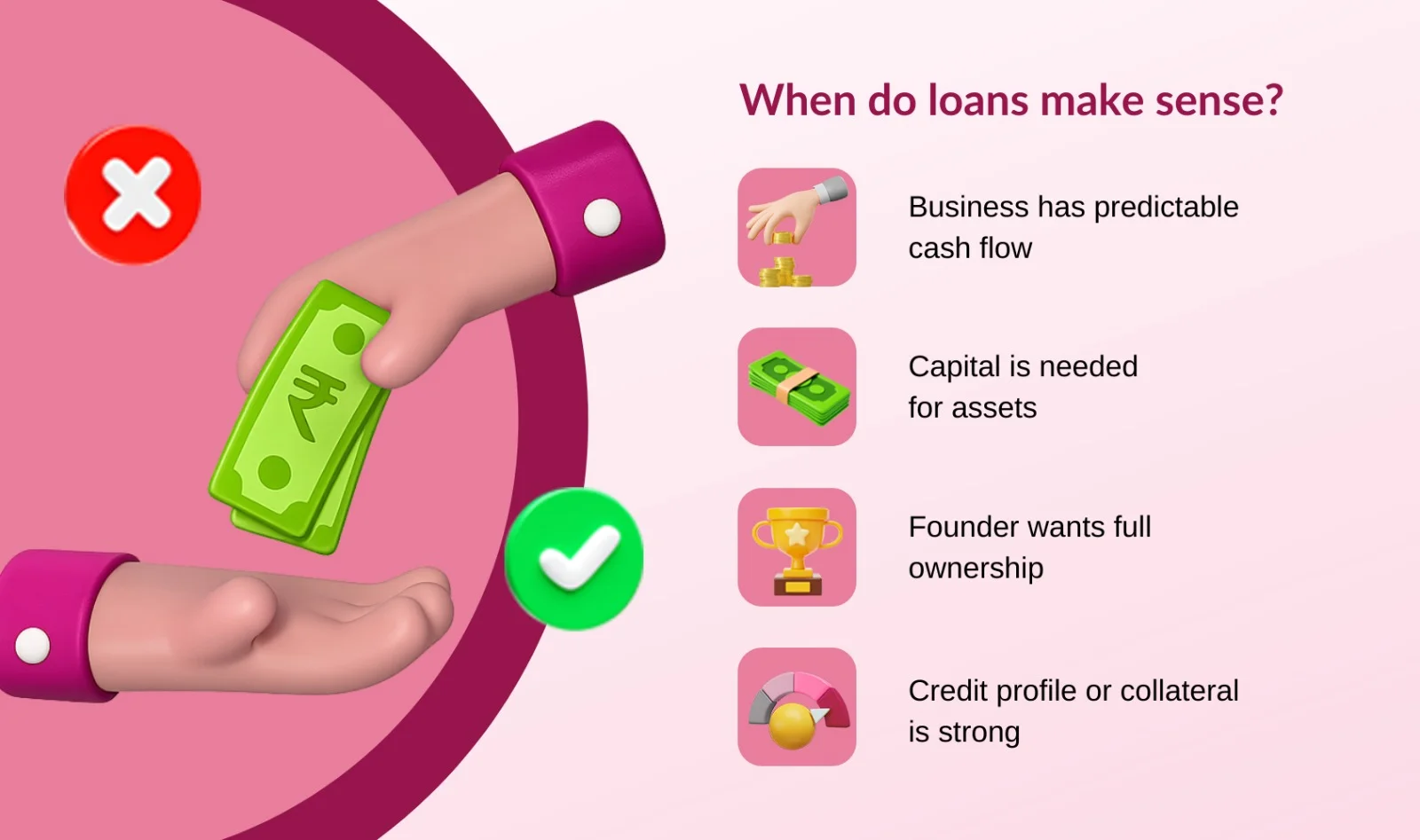
Loans provide capital without giving up ownership, but repayments are non-negotiable.
Common loan options in India
| Loan type | Key feature | Typical interest range | Best suited for |
|---|---|---|---|
| Bank Term Loans | Fixed EMIs, collateral often needed | 11–16% | Established MSMEs |
| MUDRA Loans | Government backed, easier access | 8–12% | First time founders |
| MSME Loans | Sector focused support | 10–15% | Services and manufacturing |
| Equipment Finance | Asset as collateral | 10–18% | Machinery heavy businesses |
| Working Capital Loans | Short term funding | 12–18% | Seasonal cash gaps |

MUDRA loans are available under PMMY and are designed specifically for small and micro enterprises in India.
Investor funding means raising capital in exchange for ownership and shared decision making.
Types of investors in India
| Investor type | Typical investment | What they seek | Involvement |
|---|---|---|---|
| Angel investors | ₹10 lakh–₹2 crore | Early potential | Medium |
| Venture capital | ₹2 crore+ | High growth | High |
| Strategic partners | Varies | Business synergy | Medium |
| Family offices | ₹50 lakh–₹10 crore | Long term value | Low |
| Crowdfunding | ₹5 lakh–₹1 crore | Consumer appeal | Low |
Ask yourself:
There is no perfect funding option. There is only the option that fits your business stage, mindset, and ambition.
Whether you bootstrap, borrow, or bring in investors, funding should support your product, not distract you from it. Build something customers truly value, and the right capital path will follow.
Disclaimer: This article is intended solely for informational purposes. The views expressed in this article are personal. Axis Bank and/or the author shall not be liable for any direct or indirect loss or liability incurred by the reader arising from reliance on the content herein. Readers are advised to consult a qualified financial advisor before making any financial decisions. Axis Bank does not endorse or guarantee the accuracy of any third-party content or links included in this article.
Planning your next money move? Spend a minute here

Copyright@ 2026 Axis Bank


